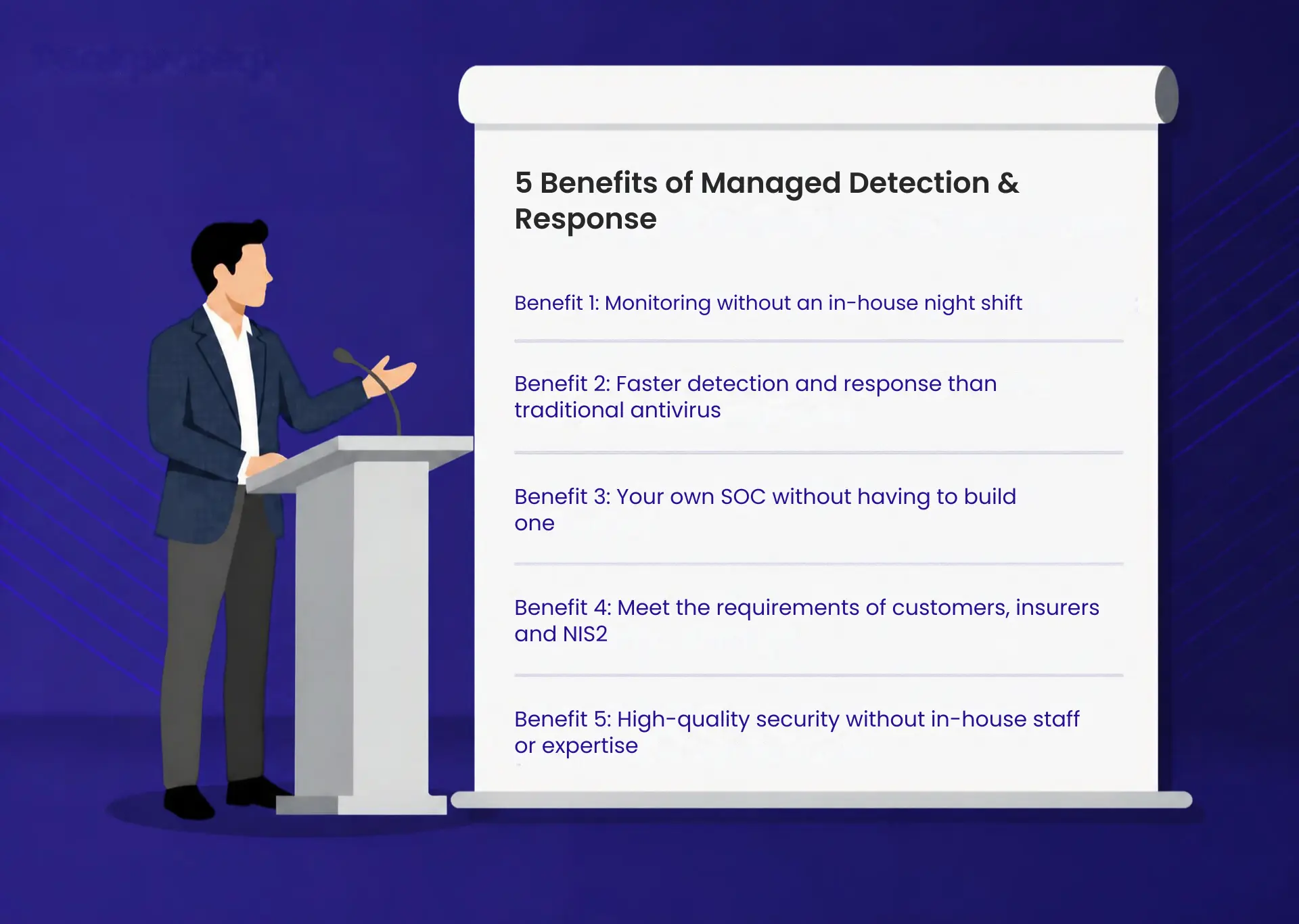
Hackers don't stick to office hours. In fact, they plan around them. An attack that starts on a Friday at 11:00 PM has until 8:30 AM on Monday morning if no one is watching. That is 57.5 hours during which someone can walk through your systems undisturbed, copy files, and locate backups to encrypt them first.
At most of the SMEs we speak with, no one is responsible, security is left to one person, or the IT provider handles it on the side. If this keeps the business running and there are few disruptions, that is convenient, of course. But these key figures in your company do go on vacation, they sleep (hopefully), and they often have many other responsibilities as well.
24/7 monitoring means someone is watching even outside of office hours. It’s not just an email notification that ends up in a folder and isn't picked up until 8:37 AM on Monday. An analyst who sees a login from a strange country followed immediately by a forwarding rule being created in your mailbox (a classic sign of a compromised account) can immediately revoke the sessions for that account and block the account itself. This prevents further damage, including to your customers.
Antivirus works with a predefined list of known malware. If the malware used to take over your computer is on that list, it gets blocked. If the hacker uses a different variant, the malware has free rein. Antivirus is a fine tool against old, known threats, but you will never see an attacker who logs in with a stolen password. They use your own systems, your own accounts, and your own tools.
That is where you immediately see the benefit of MDR. MDR looks at behavior. What is normal for this account, this laptop, this server? And what deviates from that? A process that suddenly rewrites hundreds of files or an employee who uploads ten gigabytes to unknown cloud storage at 4:00 AM. How that threat detection works is explained in more detail in a separate blog.
According to the IBM Cost of a Data Breach Report 2026 it takes an average of 241 days for an organization to discover and contain a data breach. Eight months. The Sophos Active Adversary Report 2025 shows what happens when someone is watching: at organizations using an MDR service, an attacker was discovered within a median of 1 day, compared to 7 days for incidents where an investigation team was only brought in afterward.
A SOC (Security Operations Center) is a team that monitors an organization's digital environment during the day and outside of office hours. Large banks often have their own SOC. For a company with 20, 50, or 100 employees, that is often not a realistic option.
A week has 168 hours. A full-time employee works about 36 to 40 of them. To cover every hour, you would need four to five FTEs, and that’s without anyone taking a vacation or calling in sick. If you include that, you end up with six or more security analysts.
On top of that, you have:
MDR flips that equation. You share the team, the tooling, and the night shifts with other organizations, paying per user, server, or endpoint. You get the functionality of a SOC without having to build, staff, and run one yourself.
Is your organization growing, or do you want to monitor your firewalls and cloud environment as well? Then SOC-as-a-Service is the next step. You can read about where the tipping point between the two lies in MDR vs SOC-as-a-Service.
A few years ago, security was something you handled on your own. Now, your customers and suppliers are asking for it too. Sometimes from three sides at once.
Customers
Larger clients and existing customers are increasingly including security questionnaires with requests for proposals or contract renewals. Do you have endpoint security? Is your environment monitored? How quickly do you respond to an incident? This is partly due to NIS2: organizations that fall under it must also manage risks in their supply chain. If you are a supplier to such an organization, those requirements are passed on to you, even if you don't fall under NIS2 yourself.
Insurers
Anyone applying for cyber insurance receives a list of questions. Multi-factor authentication, backups, and increasingly: do you use EDR or MDR instead of standard antivirus? The answer determines your premium, your deductible, and sometimes whether you are accepted at all. And if things go wrong, the insurer checks whether you actually did what you stated on the form.
NIS2
The European NIS2 directive (known in the Netherlands as the Cyber Security Act) imposes a duty of care and a reporting obligation on organizations in essential and important sectors. This reporting obligation is strict: an initial warning within 24 hours of discovering a significant incident, a notification with an initial assessment within 72 hours, and a final report within one month (Article 23 NIS2).
You won't meet those deadlines if you only discover an attack after three weeks. MDR ensures you spot the incident in time, while simultaneously providing the logging, timeline, and reporting you need to make the notification and demonstrate that you take your duty of care seriously.
MDR won't make you NIS2-compliant overnight. You also need policies, risk analyses, and agreements. But for the "timely detection and response" component, it is the most direct solution.
Benefit 3 was about money and capacity. This benefit is about something you cannot simply purchase: expertise and personnel.
Assessing an alert sounds simple, but in practice, it requires expertise. Is this a real attack or an employee logging in from a holiday home in Spain? Is that PowerShell script a maintenance task by your system administrator or the first step of an attacker scouting the network? To make that distinction, you need to know how attackers work, which techniques and tactics they use, and what normal traffic looks like within your organization.
You don't build that knowledge by looking at it for an evening now and then. It is a profession. With MDR security, you bring that expertise in-house without having to hire staff.
What this gives you:
The MDR benefits listed above do not carry the same weight for everyone. Not every company needs MDR. A sole proprietorship with a laptop and a webshop on a managed platform would benefit more from setting up proper backups and multi-factor authentication. However, if you recognize yourself in two or more of these points, MDR is worth considering:
At Peakproteqt, the choice is quite straightforward. If your company has between 1 and 25 employees, MDR Essentials is a great fit. You get monitoring for endpoints, servers, Microsoft 365, and users, including incident response (as far as possible). For larger organizations, choose MDR Premium, which includes automated response, monthly reports, threat intelligence, and more comprehensive monitoring of your entire business. You can find exactly what each package monitors and costs on the MDR page.