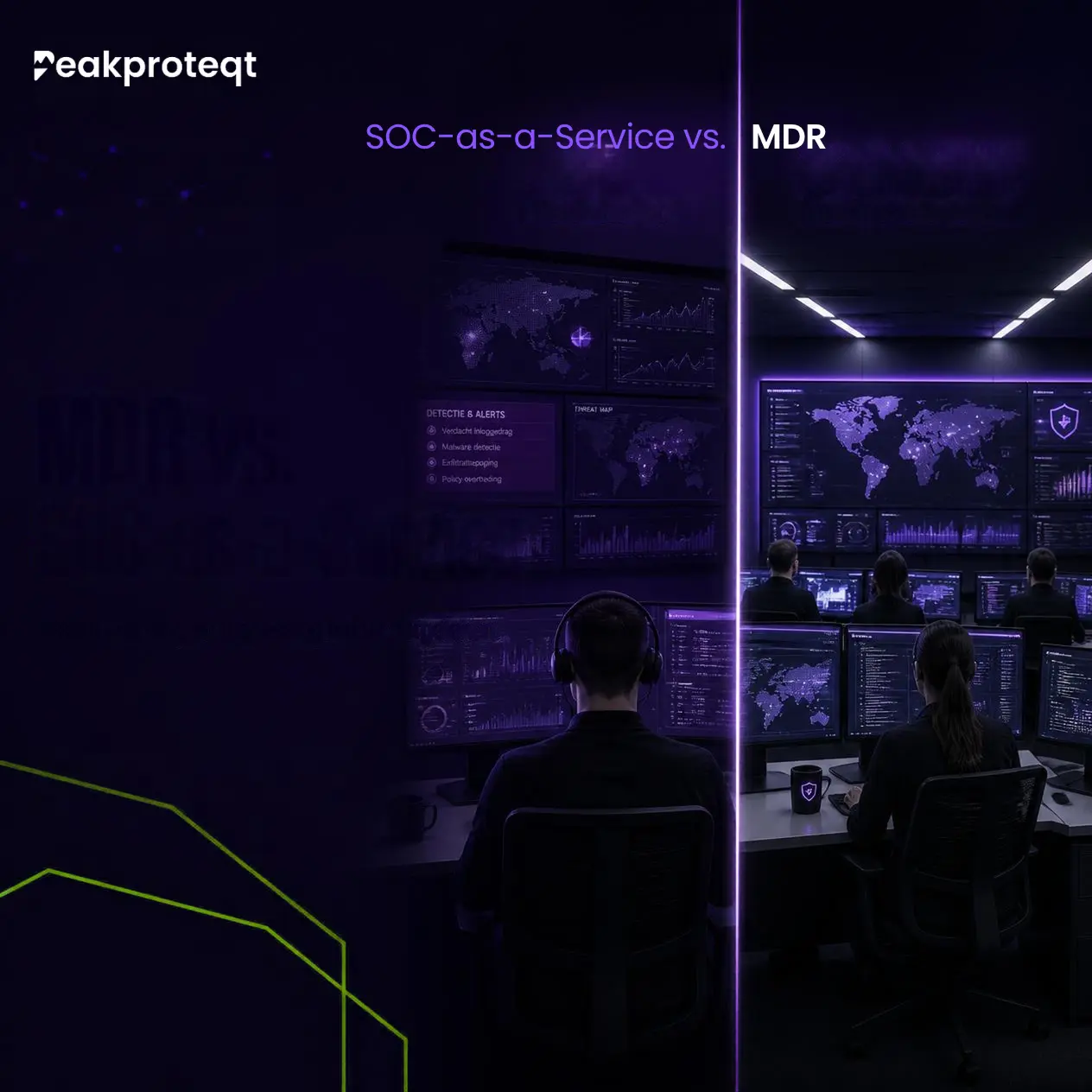
MDR stands for Managed Detection & Response: you outsource the monitoring of your IT environment to a team that keeps a constant watch, even outside of office hours. The difference between this and a standalone antivirus program, EDR (Endpoint Detection & Response), or firewall lies in what happens after an alert. A tool provides a warning, but MDR ensures that someone evaluates that warning and actually takes action.
This works in three steps. First, detection: continuous monitoring of your endpoints, servers, employees, and your cloud environment. Then, analysis: where an analyst determines whether an alert is noise or a genuine threat. And if it is a threat, response: isolating malware, blocking an account, or revoking sessions. Just a few examples of response.
The focus of MDR is often on workstations, servers, employees, and your Microsoft environment. This is what we frequently see in practice, but the focus can, of course, be broader. Peakproteqt provides this in two packages: MDR Essentials for companies with up to approximately 15 to 20 employees, featuring basic monitoring of endpoints and employees, and incident response on a best-effort basis. The more extensive version is MDR Premium. The premium model offers better response times, more insight into your environment, and dark web monitoring.
This makes MDR the right choice if you primarily want to know if someone with malicious intent is on your laptops, servers, or in your mailboxes, and if immediate action needs to be taken. For most SMEs without their own security team, this is often a huge improvement for their organization. Especially since the mindset today is no longer if we will be hacked, but when.
A Security Operations Center (SOC) is the combination of people and technology that collects and evaluates all signals from your IT environment. SOC-as-a-Service means that you purchase that team and technology as a service, without having to build a team or purchase tooling yourself. With this service, analysts and tools monitor continuously, filter out the noise, and intervene as soon as something is actually wrong.
The service revolves around four functions:
Where MDR focuses on endpoints and identity, SOC-as-a-Service (MDR Premium) takes monitoring a significant step further across your entire environment. All signals and logs are consolidated into one central platform known as a SIEM (Security Information and Event Management). This includes 200-plus additional detection rules on top of what MDR already covers, along with a monthly report detailing what has occurred, which actions were taken, and which vulnerabilities remain open.
For comparison, building your own SOC typically costs between 200,000 and 500,000 euros in startup costs, plus 350,000 to 550,000 euros annually for personnel. Furthermore, it usually takes 6 to 12 months before your SOC is operational. At Peakproteqt, we aim to achieve this within 2 to 4 weeks. In numbers, this means your SOC service is up and running approximately 90% faster and is 70% cheaper than building it yourself.
MDR monitors endpoints, your network, and your Microsoft environment. SOC-as-a-Service monitors that, plus the rest of your infrastructure via SIEM (think firewalls, other network traffic, applications, databases, and more) and provides the reporting you need for audits or NIS2. In short: MDR is the detection and response layer; SOC-as-a-Service is that layer plus the oversight and accountability surrounding it. SOC-as-a-Service therefore goes a step further.
MDR is priced per employee, endpoint, and server. Via the price calculator on our website, you can see what this means for your organization, with no hidden startup costs. The same applies to SOC-as-a-Service (MDR Premium). With a fixed monthly rate per unit: 15.72 euros per endpoint, 60.62 euros per server, and 15.72 euros per user, excluding VAT. Both have no startup costs. The difference lies in what is included in that rate: with SOC-as-a-Service, you are contributing to the SIEM centralization, monthly reporting, and, of course, maintenance, incident response, and everything that entails.
MDR is up and running within a few days: intake, connecting your environment, and you're ready to go. SOC-as-a-Service takes more time to implement. Count on at least 2 to 4 weeks. This is because the intake is broader. Your entire environment is inventoried and connected. Additionally, things need to be tested to ensure everything runs smoothly. After all, you want everything in scope and no unsecured servers left behind. Even so, this is still a fraction of the 6 to 12 months it takes to build your own SOC.
No, not as two separate products side-by-side. At Peakproteqt, SOC-as-a-Service is the form MDR takes once your organization grows. We also call this MDR Premium. This kicks in when a company reaches a size of 15 to 20 employees or more. You don't buy MDR plus SOC on top of it; you grow from Essentials to Premium to a full SOC-as-a-Service as you acquire more workstations, servers, employees, and compliance obligations.
Those obligations are not hypothetical. Since August 15, 2026, more organizations fall under NIS2, and one of its requirements is that you must be able to demonstrate what you are doing regarding detection and response. That is exactly what the monthly reporting of SOC-as-a-Service is intended for.
Choose MDR if you have fewer than 15-20 employees, want high-quality security monitoring, and want to reduce the impact of cyberattacks.
Choose SOC-as-a-Service if you have more than 15-20 employees, multiple servers or locations, need to demonstrate your security measures to a cyber insurer, client, or regulator, and want someone to intervene within 10 minutes if something goes wrong.
Still unsure? Take a look at the pages for MDR and SOC-as-a-Service for current packages and pricing, or schedule a free consultation. We will look at the number of workstations, servers, and compliance requirements applicable to your business together and advise you on which package is the best fit. No strings attached.